RustIron brings a modern approach to web hosting and server management through a unified, Rust-powered platform designed for control, clarity and technical precision.
Experimental pre-release · v0.2.0 · not yet for production
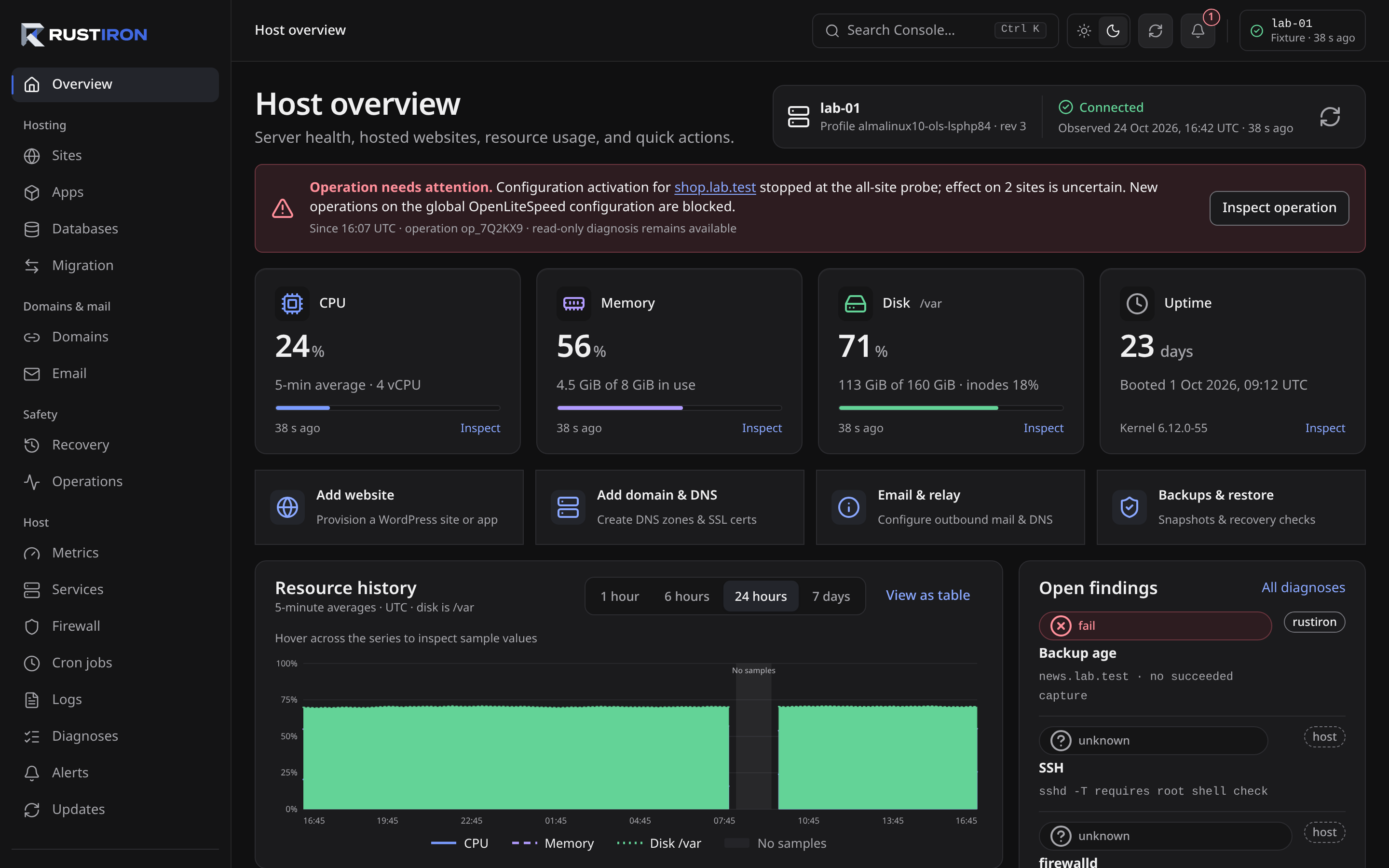
FIG. 01 — RustIron Console, host overview · sample data
03 / Positioning
Your infrastructure. Your control.
RustIron is an open-source hosting panel for WordPress, EmDash CMS, modern full-stack apps and classic HTML and PHP sites — on servers you control.
It orchestrates mature infrastructure — OpenLiteSpeed, MariaDB, PowerDNS, firewalld and systemd — instead of reinventing it. Every change is a reviewed plan, applied by a separate executor that checks it independently. Your sites keep serving even when RustIron is stopped.
P.01
Rust-powered foundation
Coordinator, executor and CLI are written in Rust, with typed contracts at every boundary.
P.02
Unified management
CLI, Console and automation share the same operation contracts — one model, three ways in.
P.03
Infrastructure visibility
Ownership-aware inventory, drift and open findings. Unknown state is reported as unknown, never as success.
P.04
Operational control
Readable plans you review and sign before anything changes on the host.
04 / The Console
Everything under control.
The RustIron Console shows the whole host at a glance — sites, apps, domains, recovery and the state of every operation.
Host health, resource history, quick actions and open findings on one screen — with interrupted operations called out, not hidden.
One platform. A unified infrastructure experience.
Host anything
Every kind of site. One panel.
WordPress
OpenLiteSpeed · LSPHP · LSCache
EmDash CMS
new sites, or move from WordPress
Full-stack apps
Node.js · Bun
HTML, CSS & PHP
static and classic PHP sites
From a blog to a full-stack product, each site gets its own isolated space, its own backups and the same simple workflow.
One contract
CLI Console Automation
Same plans, same results, whichever way you work.
WordPress hosting
Isolated WordPress sites on OpenLiteSpeed and LSPHP.
SiteProfileStatus
news.lab.testlsphp84● serving
shop.lab.testlsphp84● serving
portfolio.lab.testlsphp84● serving
Provision from a reviewed plan, run maintenance from a fixed catalogue, rotate credentials, eject or delete — with no generic shell, SQL or WP-CLI endpoint.
Modern apps
Node.js and Bun, confined per app.
node_22_v1bun_1_v1
rustiron-app@<app>.service
OpenLiteSpeed proxy → loopback port
Pinned runtime profiles, memory and task limits, and secrets that never enter plans or the browser. EmDash CMS sites run the same way.
DNS & domains
example.comA
example.comMX
_dmarcTXT
PowerDNS, signed changes.
Zone import and record changes go through signed plans, with zone transfer to your external secondary.
Recovery
capture
encrypt
verify
probe
Backups you can prove.
Encrypted captures with separate consistency and integrity results, and restore probes that test them.
Separate identities under enforcing SELinux, with confinement tested rather than assumed.
06 / Architecture
Precision at every layer.
Management flows down one narrow, checked path. Website traffic never touches it: visitors reach OpenLiteSpeed directly, so sites keep serving when RustIron stops.
L1
Interfaces
CLI · Console · automation
plan request
L2
Coordinator unprivileged
builds plans · keeps inventory · holds no production keys